
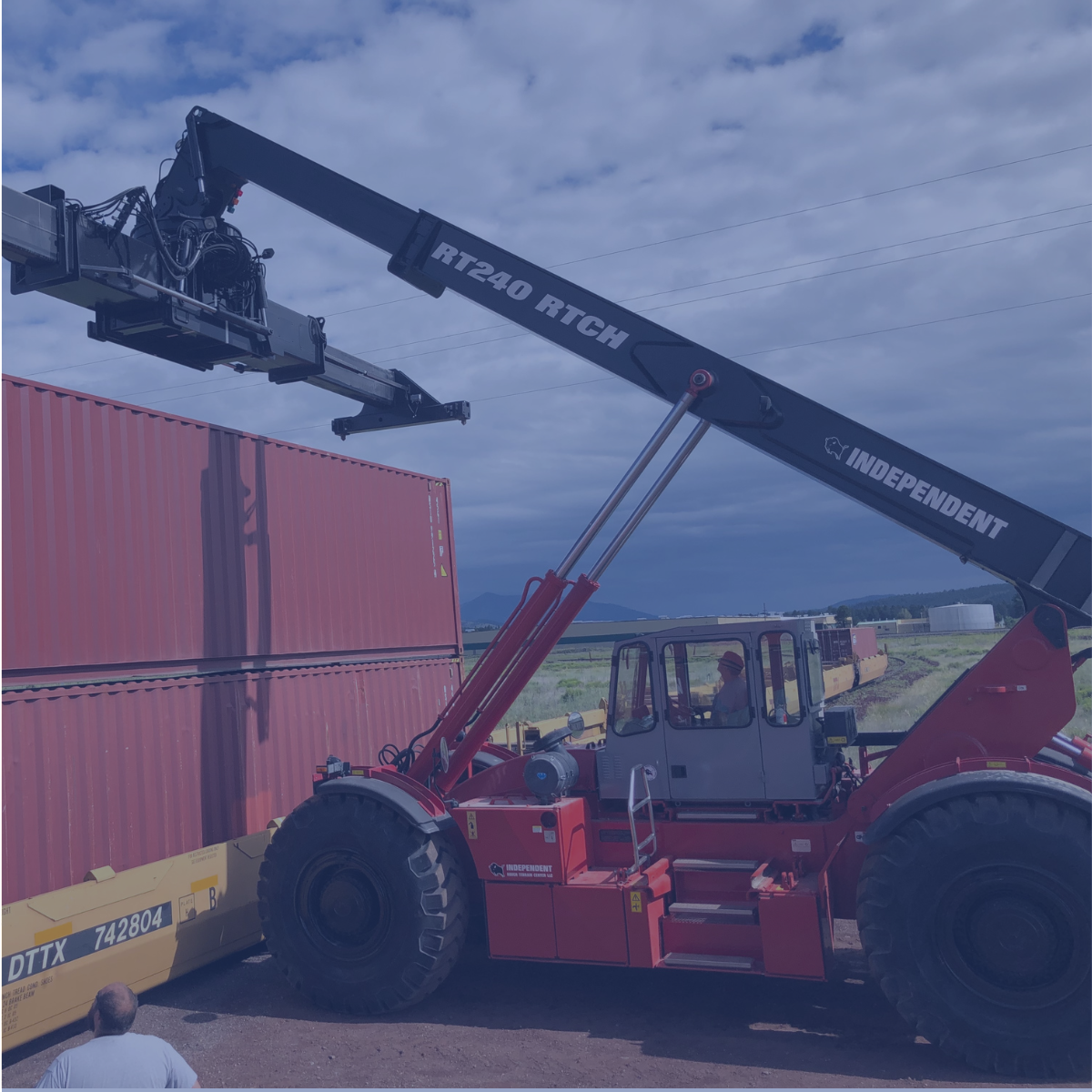
Rail has long been one of the most efficient ways to move freight across the country. As a key component of modern rail logistics, it offers lower transportation costs, reduced emissions, and the ability to move large volumes of cargo over long distances. Yet despite these advantages, many businesses still rely almost exclusively on trucks.
The reason isn’t that rail lacks capability. It’s that many facilities simply don’t have practical access to it.
Bridging that gap requires more than expanding rail infrastructure. It requires new ways to bring rail operations closer to where freight originates. This is where innovative equipment like the Rough Terrain Container Handler (RTCH) is changing what’s possible.
The Challenge Facing Modern Rail Logistics
While North America has one of the world’s largest rail networks, many manufacturers, distribution centers, military installations, and industrial facilities are located miles away from an active intermodal terminal.
Without direct rail access, freight often travels by truck to the nearest terminal before ever reaching the rail network. This additional transportation step increases:
- Transportation costs
- Transit time
- Fuel consumption
- Equipment utilization
- Supply chain complexity
For many organizations, these “first-mile” challenges make rail less practical, even when it would otherwise be the most efficient transportation option.
The Missing Link Between Road and Rail
The future of rail logistics isn’t necessarily about building more permanent terminals. It’s about creating greater flexibility.
Mobile material handling solutions allow organizations to load and unload containers wherever operations demand, eliminating the need for every facility to have fixed infrastructure.
A Rough Terrain Container Handler serves as the connection between trucks, containers, and rail by moving heavy loads in locations where traditional container handling equipment cannot operate effectively.
Instead of relying solely on paved ports or permanent intermodal facilities, organizations can handle containers across military installations, industrial sites, temporary rail sidings, distribution centers, and other challenging environments.
How the RT250/240 Expands Rail Opportunities
The RT250/240 was originally engineered to move containers in demanding environments where reliability and mobility are essential.
Its ability to operate on uneven terrain makes it valuable for applications beyond traditional handlers. The RT250/240 can support operations by:
- Loading and unloading shipping containers near rail lines
- Supporting temporary or mobile intermodal operations
- Handling containers at remote industrial facilities
- Improving cargo movement between trucks and railcars
- Operating where conventional container handlers cannot
Rather than bringing freight to specialized equipment, the equipment can be brought closer to the freight.
That flexibility opens new opportunities for organizations looking to increase rail utilization without investing in permanent infrastructure.
Supporting More Flexible Rail Networks
Today’s supply chains must adapt quickly to changing customer demand, labor availability, transportation costs, and network disruptions.
Organizations are increasingly looking for equipment that can perform multiple roles while reducing dependence on fixed infrastructure.
A Rough Terrain Container Handler helps support these evolving operations by providing:
- Greater operational flexibility
- Improved container mobility
- Faster loading and unloading
- Reduced equipment requirements
- Better utilization of existing rail assets
As more companies explore ways to diversify transportation options, flexible material handling equipment becomes an important part of modern logistics strategies.
Why Mobility Matters
Traditional container handling equipment performs exceptionally well inside established ports and terminals. However, not every operation takes place on smooth pavement or within a dedicated intermodal yard.
The RT250/240 is designed for environments where rough terrain, limited infrastructure, or changing operating conditions are part of everyday work.
This allows organizations to extend container handling capabilities into locations that were previously difficult or costly to serve.
Instead of viewing rail as something that only exists at major terminals, businesses can begin thinking about rail access as something that can be expanded through mobile equipment and innovative logistics planning.
The Future of Rail Logistics
As supply chains continue to evolve, flexibility will become just as important as capacity.
Organizations that can quickly move freight between trucks, rail, and remote facilities will be better positioned to reduce transportation costs, improve efficiency, and respond to changing market demands.
The Rough Terrain Container Handler and the RT250/240 represent more than material handling equipment. They provide a practical solution for connecting freight with the rail network in places where traditional infrastructure falls short.
By helping bridge the gap between road and rail, these machines are becoming an important part of building a more resilient, flexible, and efficient freight network.